
Wishful Thinking - One year on.
What I'm doing differently now from my Plan of a year ago

Its March 2026 - one year on from my first Substack post and the Plan I was going to follow over the past twelve months. Not surprisingly, I’ve made changes - not the least being the inclusion of synthetic miticides in my treatment program. I don’t like to do this, but at this stage of Australia’s varroa story I would argue you have little choice. However, I don’t intend to do this long term. I am hoping to only need this compromise until the re-infestation rates fall……..fingers-crossed.
Re-Infestation
Despite finishing organic treatments and confirming a high a high degree of efficacy, my mite testing would again show 30+ mites in a wash of a 1/2 cup of bees in a couple weeks. The legally available organic treatments included in the earlier version of the Plan appropriate for the environments in which I keep my bees could not counter the levels of re-infestation from the wild/feral honeybee population and collapsing managed colonies around me
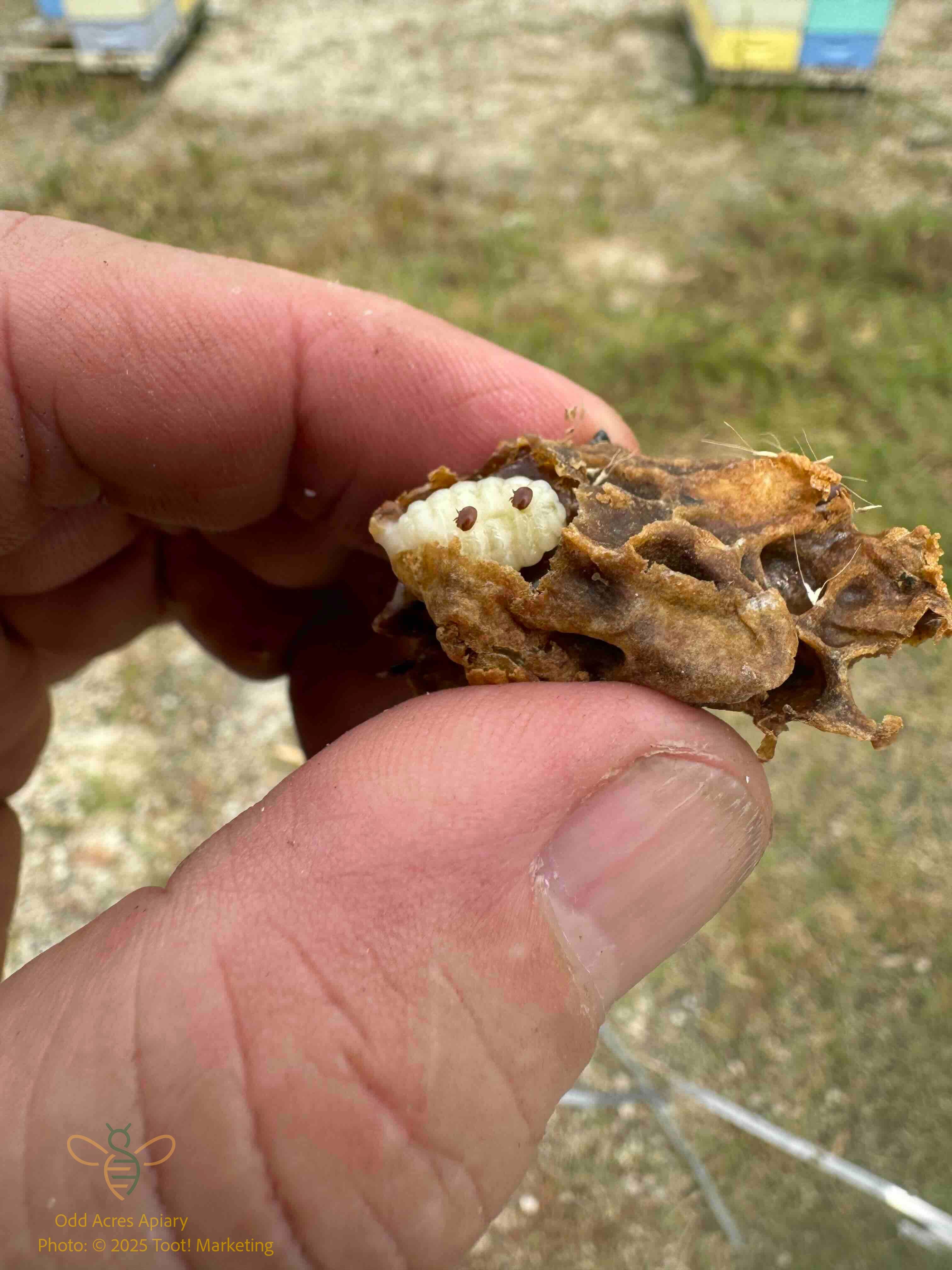
Having to re-treat and test 300 colonies every 2-3 weeks over November through March puts an enormous load on labour and cost and is simply not sustainable for my operation. I may not go broke, but the heat of long Summer days to do all this extra work will likely break me in other ways. Yet, in the heat the tantalising opportunity for relief with a quick application of Bayvarol buys me eight to ten week’s break from having to treat a colony; time and effort that I could then apply elsewhere. Then of course, the recent announcements regarding mite resistance to Bayvarol and pyrethroid based treatments such as Apistan suggests that even synthetic miticides may not be the “crutch” I have depended on for much longer - so more changes are needed to said Plan.
Changes to the Plan
Most of the experience I am about to share with you is from two years managing a research apiary of about 120 colonies on behalf of the Australian Queen Bee Breeder’s Association (AQBBA) varroa sensitive hygiene (VSH) Collective near Newcastle, NSW. You would recall Newcastle was “Ground Zero” for mites in Australia back in mid-2022. The last 12 months were the toughest as we battled re-infestation and used syntehtic miticides almost exclusively since last October. You should expect therefore that mite re-infestation may take up to several years to stabilise in a recently infested area. It is important that you keep this in mind as you face the onslaught and plan for a protracted struggle.
Now - keep in mind that this is a “research apiary” so not typical of honey production and pollination operations. We treat the colonies that can’t manage mite numbers (nearly all of them at this stage) and leave those that are coping to see how well they go and whether we breed from them or not. In this regard, our bees are not that different to everyone else in terms of mite resistance. But we do a lot of re-queening (as you would expect in a research apiary) so this aspect of the plan may not be as relevant to you. That being said, weaving re-queening in with treatments can boost their efficacy as the mites have no where to hide if the queen is not laying and the colony is very short of brood.
Late Summer/Autumn Management
We are up to this part of the year, so lets start here.
Honey supers are still on my colonies to catch the last of the Summer and Autumn flows in some areas. I am currently treating with Bayvarol which is due to come out at the end of March with the last honey harvest and colony assessments for the season. I usually re-queen in early April so I will do another mite wash to see if the mite numbers are up. If they are, then I will treat these colonies with formic acid after the old queens are removed as per last year’s Plan and before the new queens are introduced a week later. If mite numbers are low, I will wait till the end of April and test again. Likely, the mite counts will be up again and I plan to install slow release oxalic acid (OA) strips (Aluen Cap is now legal in Australia) which will get me through to June.
Winter Management
With the late Summer/early Autumn treatments described above, I really don’t expect much trouble from my colonies over Winter - especially the ones down south near Cooma and Jindabyne). Last year was fairly low key but this year may be different, especially with my colonies around Newcastle and further north. If the mite counts indicate any alarming growth trend, I can follow up with a late Winter OA dribble as described in my earlier article. Probably not the best outcome for the Spring worker bees being raised as the colony attempts to build up for the season but I am trying to keep my (synthetic) powder dry for when I really need it.
Spring Management
We will still attempt to apply formic acid around mid-September or earlier for our apiaries in mid to north coast NSW; though the re-infestation rate from last year forced us to use Apivar on one occasion - so we will keep this in reserve if needed again. The main objective at this time of the year is to have as few mites in our colonies as is humanly possible so we don’t have to treat until late Summer. If you have a small apiary and the time and labor resources then you can employ some mechanical manipulation. Otherwise, treat with Apivar before the supers go on for the late Spring/early Summer flows.
Summer Management
At this point your bees should be plentiful, vigorous and largely mite free (no more than a mite or two per wash). The mites will have missed the opportunity in Spring to grow with the colony and as a result, the Summer treatments should be reduced. Again - keep Bayvarol in your back pocket as an emergency treatment if need be - particularly as we get to late Summer in which case were are back to the beginning of this version of the Plan.